https://www.right-to-education.org/girlswomen
There are some barriers to education. One of the most major barriers is poverty. Poverty hinders many from having the right to have access to education and this results in a repeated cycle of poverty. In the past, if one could only afford to send one of their children to school, it would have most likely been the boy as many women and girls around the world are forced to spend many hours in a day doing household chores, fetching water and caring for relatives while the boys attended school.
For example, according to the Global Education Monitoring report, in all regions except sub-Saharan Africa, children from rich families, girls and boys, get to attend all levels of basic education. However, girls from poor countries in sub-Saharan Africa, Northern Africa and Western and Southern Asia, are less likely than their male peers to attend school and this lack of participation increases at higher education levels.
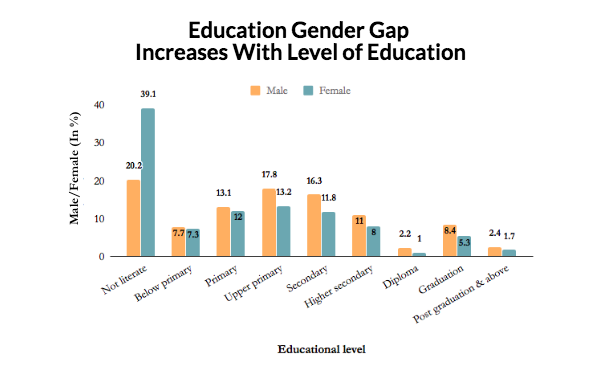
Less than 40 percent of countries offer girls and boys equal access to education and only 39 percent of countries have equal proportions of the sexes enrolled in secondary education. As shown on the first graph above, males have a higher annual income than women in every aspect despite receiving the same level of education attainment. From the second graph, it shows the percentages of each gender receiving education. Males outweigh females. The number of illiteracy for females are also much higher compared to females. It is stated that there are approximately 774 million illiterate adults in the world and two-thirds of them are women. There are approximately 123 million illiterate youths and 61 percent of them are girls. Women’s share in the illiterate population has not budged in 20 years. These facts not only affect women but their children as well. A child born to a mother with the ability to read is 50 percent more likely to survive past age five.
 Boys for Girls